You Can't Scale a Bottleneck
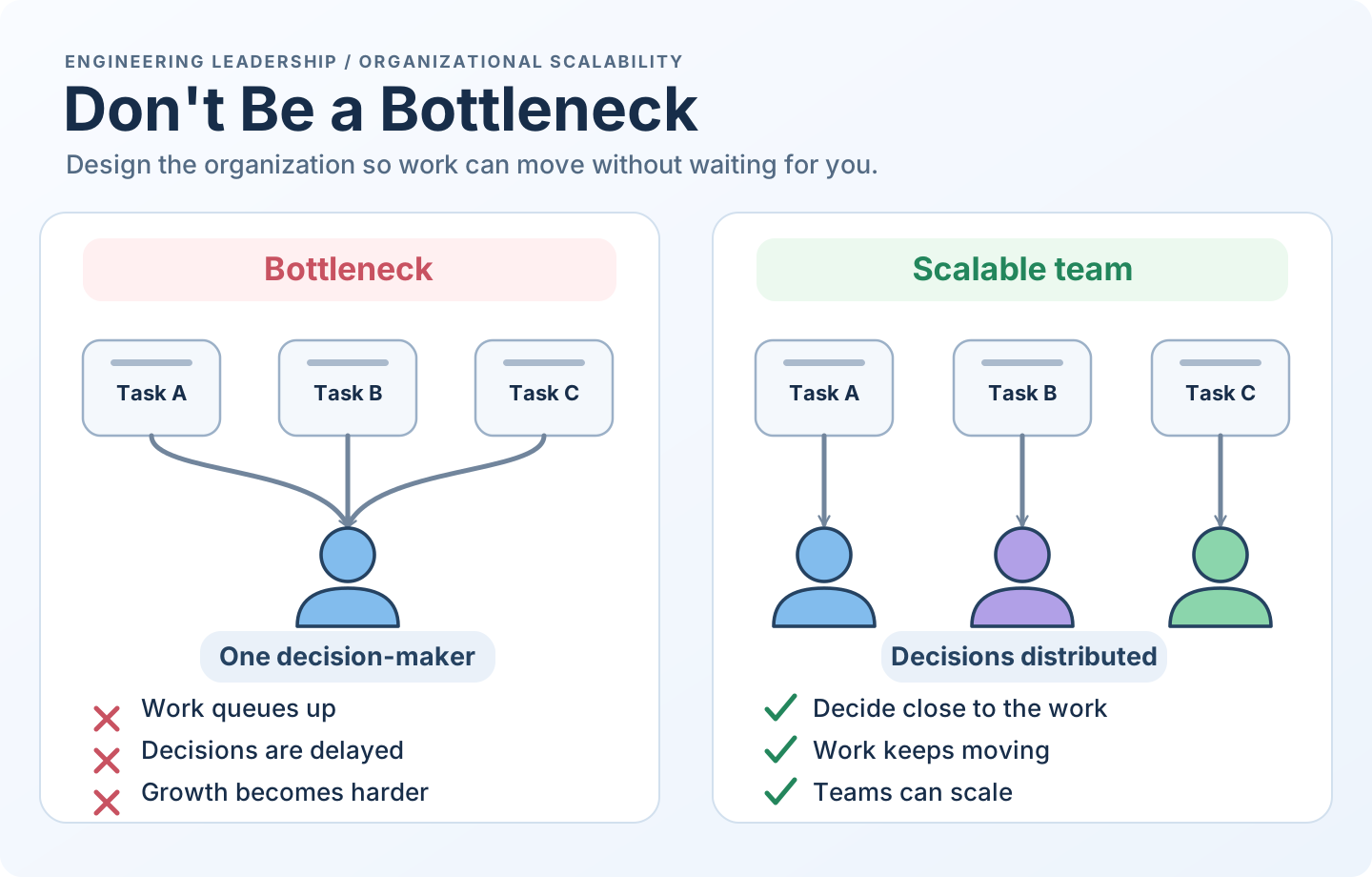
At lunch recently, a friend, described one of her previous companies. It had around 500 employees, but she said nearly every decision needed to go through the CEO. At the same time, she was expected to ship products quickly.
She was given the resposibility of moving fast, but not the authority, the organization was set up to wait for one person’s decisions.
A leader can become a bottleneck even when they’re trying to be helpful.
When every decision requires a manager’s input or approval, the organization eventually moves at the speed of that manager.
The natural reaction is to respond faster and make more time for everyone. But that doesn’t solve the underlying problem: too much work still depends on one person. To change that, a leader needs to be deliberate about which decisions actually require their involvement and which should move forward without them.
This is a problem of organizational throughput, not just a manager’s workload.
You can only have three priorities
Early in my management career, I asked my manager and mentor, Tig Kindel, how he was able to juggle so many competing priorities.
He thought for a moment and told me:
You can only have three priorities at a time. You have to be very clear on what those priorities are.
I’ve thought about that advice for the better part of a decade.
Over time, I came to see it as a lesson not only about focus, but also about scaling an organization. If I needed to be involved in every problem and every decision, it wouldn’t matter how many talented engineers or managers I had. I would still be limiting what the organization could accomplish.
The scalability cost of being involved in everything
In 2015, Adrian Colyer wrote Applying the Universal Scalability Law to organisations on his blog, The Morning Paper. It’s an article that has helped sharpen my thinking about engineering leadership and scalability.
Colyer connects ideas from systems performance to organizational behavior. Two concepts stand out to me:
Contention: Multiple teams depend on one shared resource, the leader. Even if that leader is very capable, only so many requests can be handled at once.
Coherence: Decisions become more expensive when more people must coordinate to make them. Adding engineers or teams won’t automatically increase output if every change needs another review, meeting, or approval.
The analogy helps explain something I’ve seen in practice: adding capacity doesn’t help as much as it should when the same dependencies remain.
The utilization problem makes it worse. When a manager has committed every hour to meetings, projects, and decisions, even a small unexpected request creates a delay. Trying to be helpful to everyone can leave the whole organization waiting.
Being involved in more work doesn’t necessarily mean helping the organization get more work done.
The question becomes: where are decisions waiting, where are we making too many people coordinate, and what can we change so the work doesn’t have to pass through me?
That might mean removing a routine approval, defining a clear owner, agreeing on decision criteria ahead of time, or letting teams resolve issues directly instead of routing them through their managers.
When Control4 started creating its next touch screen, the T5, I was very hands on. I helped the hardware engineers choose components, I helped define what the capabilities of the touch screen should be, and how we could utilize hardware to enhance the customer experience. As the project progressed, I became less invovled. By the time the T5 shipped, I was just getting status updates from my teams. I trusted the team and gave them the responsibility and authority to move forward without me.
Remove dependencies rather than just handing off tasks
I saw this develop with my mobile engineering teams at Control4.
We needed clearer responsibilities and more consistent practices before I could delegate as much as I wanted. Otherwise, taking myself out of a decision would have created uncertainty rather than removed a bottleneck.
By 2020, we’d moved our mobile applications to a two-week release cadence. The teams no longer needed me to make the routine decisions about whether an app was ready to ship.
That didn’t happen because I told them, “You’re responsible for releases now,” and walked away.
We’d worked together on criteria for when to release, when to patch, and when to hold a release. We had monitoring in place to understand how the applications were performing, along with established ways to communicate issues and escalate concerns.
Those mechanisms changed the flow of work. Instead of waiting for my availability, the teams could evaluate the same evidence and make the decision within agreed boundaries. An unusual issue could still be raised, but routine work didn’t need to stop for me.
I received updates through staff meetings and other conversations. Problems still happened, and I was still accountable for the organization. Visibility didn’t require being part of every approval.
Making that change helped when I was given responsibility for additional teams in other technical domains. The iOS and Android teams were largely self-sufficient by then, so I could spend more of my attention where it was needed without slowing their releases.
The organization could accomplish more without making me a required step in every decision.
I wrote more about the organizational and release changes in Transforming Mobile Engineering.
Handing someone work only removes a bottleneck if they also have the authority to act. I’ve written more about that in Empower the People.
Keep the right decisions, and move the rest
Not every decision should be pushed down the organization. Some have significant cross-team consequences, financial constraints, or risks that are difficult to reverse. Those may deserve my direct involvement.
But those exceptions should be deliberate. Otherwise, “keep me in the loop” can quietly turn into “wait for me to approve it.”
I try to separate decisions into those a team can make independently, those where they should seek advice or notify others, and those that genuinely require escalation. Clear ownership, agreed criteria, and monitoring make that distinction practical.
Removing myself from one queue doesn’t help if I create a new queue somewhere else. I need to ask whether a handoff actually shortens the path from problem to decision or simply moves the waiting to someone else.
What I’ve learned
I used to think being a good manager meant being available and helping wherever I was needed. I still believe in being available, but I’ve learned that being involved in everything is not the same as helping everything move forward.
Clear priorities, decision boundaries, monitoring, and escalation mechanisms allow teams to operate in parallel rather than wait for one person’s attention. Delegation is part of that, but the real work is designing an organization where routine decisions can flow without unnecessary handoffs.
Empowering people gives them the ability to act. Removing bottlenecks makes sure the organization can use that ability.
The goal isn’t to disappear as a leader. It’s to spend my attention where it makes the most difference, without making everyone else wait.
A healthy engineering organization shouldn’t depend on its leader being involved in everything. A leader’s job is to help build one that doesn’t.